








How a cabling system is laid out
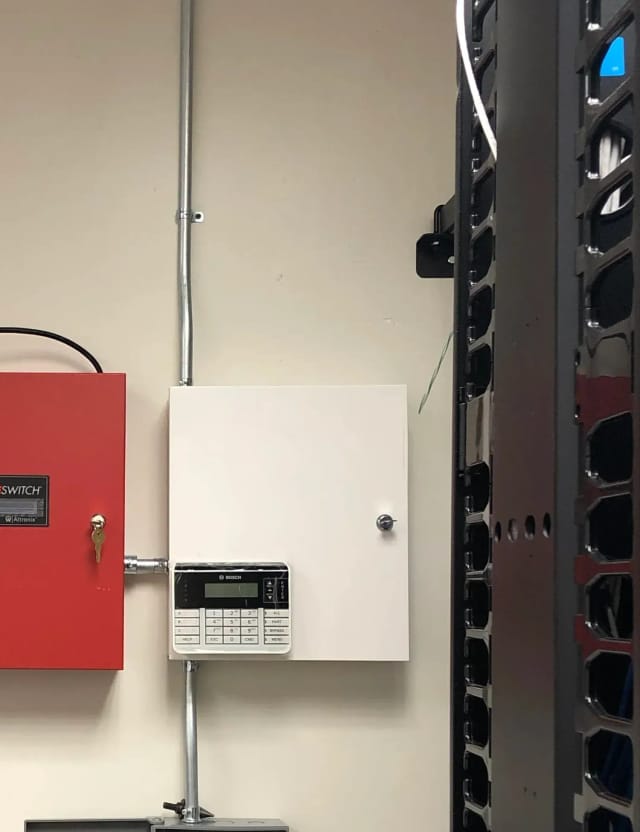
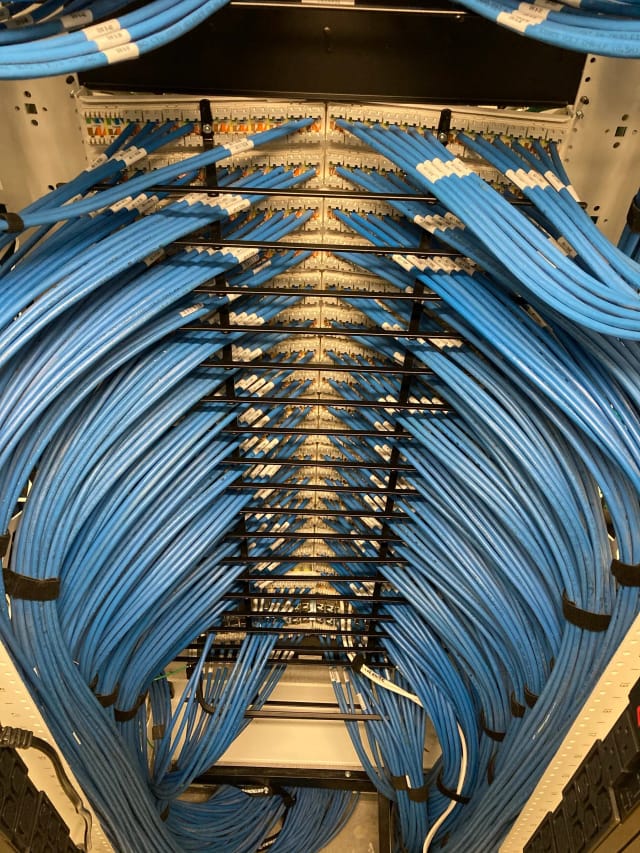
Structured cabling follows a simple shape. The main distribution frame (MDF) is where the outside lines and the core switches live. Intermediate distribution frames (IDFs) serve each floor or wing. Backbone cable, copper or fiber, runs between them up the risers. Horizontal cable runs from each closet to the outlets on its floor: a desk, a camera, a card reader, a wireless access point. Ladder rack carries the cable overhead in the closets, and patch panels give every run a fixed, labeled home in the rack. When the layout is right, adding a camera or moving a desk is a patch cord, not a project.
The 100-meter rule and why we test the permanent link
Copper Ethernet has a hard limit. For 10, 100 and 1,000 megabit Ethernet on Category 6, the maximum is 100 meters (328 feet): up to 90 meters of solid permanent link, typically from the patch panel to the wall jack, plus a total of 10 meters of stranded patch cords. Run 10 gigabit Ethernet on Category 6 and the limit drops to 55 meters; Category 6A, specified to 500 MHz, carries 10 gigabit the full 100 meters. That is why closet placement matters before a single cable is pulled.
Testing matters as much as the pull. Fluke Networks, a maker of cable testers, warns against testing only the channel when you install permanent links: under the TIA standards, high-quality patch cords can make a channel pass even when the permanent link behind them has failed. We test the permanent link, the part that lives in your walls, and give you the results.
Power over the same cable
Cameras, access points, video intercoms and many door controllers now take power over the data cable. IEEE 802.3af delivers up to 12.95 watts at the device, 802.3at up to 25.5 watts and 802.3bt up to 71.3 watts. More power means more heat in tight bundles, so we size switches for the total load and keep bundles sensible in the pathways.
Fiber for the backbone
Fiber carries the backbone where copper can't: between floors in tall buildings, between buildings on a campus, and wherever runs exceed 100 meters. Multimode fiber is cheaper to light and suits short and medium runs inside a building or campus; laser-optimized OM3 multimode supports 10 gigabit Ethernet up to 300 meters. Single-mode fiber carries far longer distances and is what telecom carriers use. The TIA-598C color code recommends a yellow jacket for single-mode fiber and orange or aqua for multimode.
Old cable comes out
Many ceilings in older buildings hide layers of dead cable. Abandoned cable is more than clutter: it fills pathways, blocks plenum airflow and adds fuel to a fire in concealed spaces, which is why the 2002 National Electrical Code began requiring the removal of abandoned communications cable that is accessible. When we recable a floor, we pull out the dead runs we can reach or tag what is reserved for future use.
In New York City, Local Law 128 of 2024 lets a licensed master or special electrician or a qualified person do low-voltage wiring under 50 volts for signaling, communication, alarm and data without an electrical permit, except where the wiring ties into life-safety or fire alarm systems.
What to prepare
- Floor plans, with desks, cameras, readers and access points marked if you know them.
- Where the closets are, or could be, and who controls the riser.
- Your IT contact and the equipment going into the racks.
- Building rules for after-hours work, freight elevators and ceiling access.
What moves cost and time
- Drop count and distance. The number of runs and their length set most of the labor.
- Ceilings and walls. Drop ceilings are quick; hard ceilings, masonry and occupied floors are slower.
- Fiber. Splicing, terminations and pathways between floors or buildings add time.
- Old cable. Removing abandoned cable is real work, and worth it.
How we run a cabling job
We walk the building free, then send a design and a written proposal with the schedule and the price. Our crew pulls, terminates and dresses every run, builds the racks, tests every link and hands you the results and labels. Every job is finished on time and on budget, or 15% off.
Sources
- Structured Cabling - Voice & Data InnoTech, old website.
- Category 6 cable, Power over Ethernet and Multi-mode optical fiber Wikipedia.
- Cabling Mistakes #1: Specify Channel Testing While Installing Permanent Links Fluke Networks.
- Calculating Ethernet Cable Overall Channel Length trueCABLE.
- Low-Voltage Cabling IAEI Magazine, May 2005.
- Local Law 128 of 2024 New York City Council.


