



Start with what each camera must see
A camera plan starts with a question for every spot: what does this camera need to show? Seeing that someone crossed the lot is a different job from reading their face at the door or a plate at the gate. The international standard for video surveillance, IEC 62676-4, puts numbers on it. Axis Communications, a camera maker, summarizes them as pixels per meter at the target: about 25 to detect a person, 63 to observe, 125 to recognize someone you have seen before, and 250 to identify a person, or about 80 pixels per foot. A 4K camera spread across a whole parking lot may only detect. The same camera aimed at a doorway can identify. That is why we place cameras by the job each one does, not by a count, and why a single wide camera rarely replaces two well-placed ones. Lighting matters as much as pixels: Axis advises a higher density as a safety margin for poor light and people who don't face the camera.
Cameras, cable and power
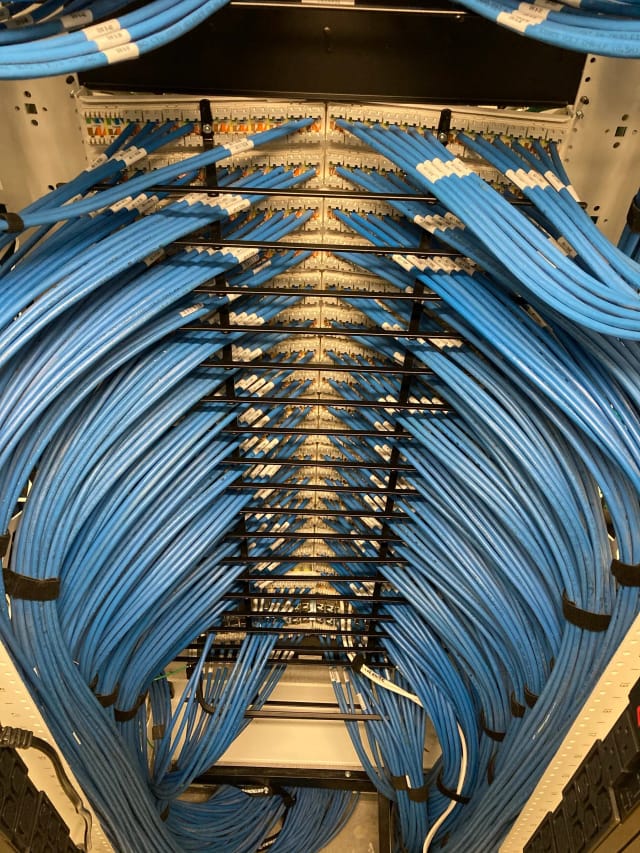
Many commercial systems today are IP cameras on network cable, powered over the same cable with Power over Ethernet. IEEE 802.3af delivers up to 12.95 watts at the camera, 802.3at up to 25.5 watts, and 802.3bt up to 71.3 watts for the most power-hungry cameras. A copper Ethernet run is limited to 100 meters, including patch cords, so cameras far from the closet need a closer switch or fiber. We also work with analog and HD-over-coax (TVI and CVI) cameras, which helps when a building's existing coax is worth keeping. We size the switch for the total camera load before we order it.
New York rules that touch your cameras
Restrooms and locker rooms are off limits. New York Labor Law 203-c says no employer may make a video recording of an employee in a restroom, locker room, or room designated for changing clothes, unless authorized by court order, and a recording made in violation may not be used for any purpose. We keep camera views out of those rooms and their doorways.
Face recognition in NYC stores and restaurants. New York City's biometric identifier law, in effect since July 9, 2021, requires retail stores, food and drink establishments and places of entertainment that collect, retain, convert, store or share customers' biometric information to post a clear sign at every customer entrance. Ordinary video is exempt as long as no software analyzes it to identify people and it isn't shared outside law enforcement. If you want face recognition analytics, we talk through the sign before we turn it on.
Who can do the wiring in NYC. Under Local Law 128 of 2024, low-voltage wiring under 50 volts for signaling, communication, alarm and data circuits needs no electrical permit when a licensed master or special electrician or a qualified person does it. Wiring that ties into life-safety or fire alarm systems stays with licensed electricians.
The brand matters for some buyers. Since March 2021 the FCC's Covered List has included Hikvision and Dahua video surveillance equipment where it is used for public safety, government facilities or critical infrastructure. If you contract with the government, tell us at the survey so we quote cameras you can use.
Keep the system yours
A camera on the internet is a computer on the internet. CISA, the federal cybersecurity agency, warns that default passwords are easily found online and recommends strong passwords, multi-factor sign-in where offered, and applying software patches as soon as they come out. We set unique passwords, give remote access only to the users you name, and keep the recorder's firmware current under service.
What to prepare
- A floor plan or a sketch of the property, with the doors, registers, stock rooms and lots that matter most.
- What you want to see: faces at entries, plates at the gate, the whole floor, or all three.
- How long you want to keep video. Storage grows with camera count, resolution and days kept.
- Who should see cameras remotely, and on which devices.
- Your network contact, if the cameras will share your network.
What moves cost and time
- Camera count and type. PTZ, panoramic, plate and thermal cameras cost more than fixed domes and take longer to set up.
- Cable paths. Open ceilings are quick; hard lids, masonry, outdoor runs and lifts add hours.
- Recording. Days of storage and the number of cameras recorded at full resolution size the recorder.
- Reuse. Good existing cable or coax can stay; failing cameras and recorders usually can't.
How we run a camera job
We walk your building free, then send a camera plan and a written proposal with the schedule and the price. Our crew installs, aims and tests every camera day and night, and we train your team on the desktop and phone apps. Innovation Technology & Security LLC holds a New York State alarm installer license, #12000376737, and every job is finished on time and on budget, or 15% off.
Sources
- Commercial Surveillance Systems InnoTech, old website.
- Pixel density based on IEC 62676-4:2014 Axis Communications.
- Power over Ethernet and Category 6 cable Wikipedia.
- Labor Law section 203-c New York State.
- New York City Biometrics Law Takes Effect in July 2021 Davis Wright Tremaine.
- Local Law 128 of 2024 New York City Council.
- Public Notice DA 21-309: the Covered List Federal Communications Commission.
- Secure New Internet-Connected Devices Cybersecurity and Infrastructure Security Agency.


