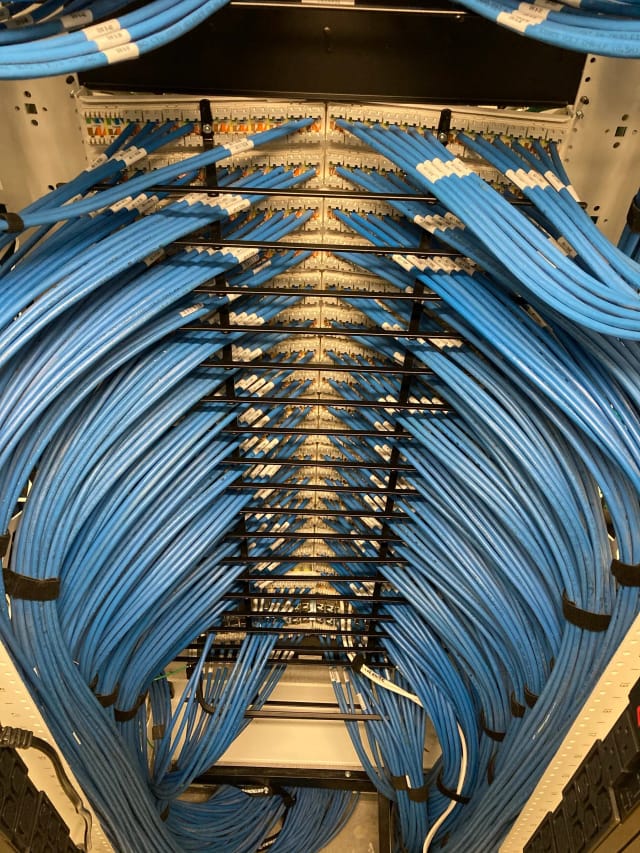
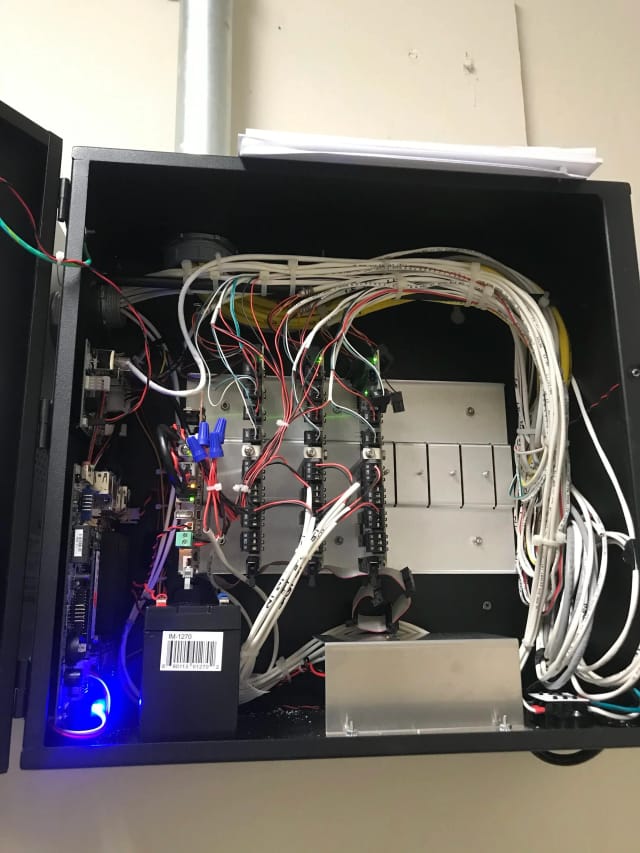









Cabling is the part of a security project nobody sees once the ceiling tiles go back. It is also the part that decides whether cameras stay online, readers stay fast and the next upgrade is a patch cord or a rewire. A few standards and numbers cover most of what an owner needs to know.
The channel and the permanent link
Twisted-pair Ethernet is built around two lengths. The channel is the whole connection from one active device to another, patch cords included, and per industry standards it should not exceed 100 meters (328 feet). The permanent link is the fixed part in the walls and ceilings, typically from the patch panel in the closet to the jack at the desk or device, and its maximum is 90 meters. The difference, up to 10 meters in total, is left for the stranded patch cords at each end.
That is why closet placement is decided before cable is ordered. A camera on the far side of a warehouse that sits 120 meters from the closet can't be reached with copper alone. It needs a closer switch fed by fiber, or a second closet.
Category 6 or 6A
For gigabit Ethernet, Category 6 cable reaches the full 100 meters. Push it to 10 gigabit and Category 6 is limited to 55 meters. Category 6A is specified to 500 MHz with better alien crosstalk performance, and it carries 10 gigabit the full 100 meters. Some manufacturers advertise runs past 100 meters, but those fall outside the TIA standard. For most security devices gigabit is plenty; Category 6A earns its cost on backbone-like runs, wireless access points and anything you expect to upgrade.
Test the permanent link
Fluke Networks, a maker of cable testers, lists specifying channel tests for new permanent links as cabling mistake number one. Under the TIA standards, a compliant permanent link plus compliant patch cords always produces a passing channel, which also means very good patch cords can make a channel pass when the link behind them has failed. Patch cords get replaced; the cable in the walls doesn't. Ask for permanent link test results and keep them.
Power over the same cable
Cameras, access points, video intercoms and many door controllers take power over the data cable. IEEE 802.3af delivers up to 12.95 watts at the device, 802.3at up to 25.5 watts and 802.3bt, now part of the 802.3 standard, up to 71.3 watts using all four pairs. Before the switch is bought, add up the power budget of every device on it, and leave room for the cameras you'll add next year.
Fiber for the backbone
Fiber carries the backbone between closets, floors and buildings. Multimode fiber uses cheaper light sources and suits short and medium runs; laser-optimized OM3 carries 10 gigabit Ethernet up to 300 meters, and OM4 supports 40 and 100 gigabit links of 125 meters. Single-mode fiber carries much longer distances. The TIA-598C color code recommends yellow jackets for single-mode and orange or aqua for multimode, so you can often tell them apart at a glance.
Abandoned cable has to go
Old buildings collect dead cable in their ceilings: every tenant and every upgrade adds a layer. Abandoned cable fills pathways, restricts airflow in plenum ceilings, and adds fuel to a fire in concealed spaces, where most of the combustible material often comes from communications cabling. The 2002 National Electrical Code began requiring removal of accessible abandoned cable; cable kept for later should be tagged for future use. A recabling job is the right time to pull it out.
What to ask for
- A drawing with closet locations, pathways and cable counts.
- The cable category for each run, and fiber where runs exceed the channel limit.
- Permanent link test results for every run, with labels that match the drawing.
- Removal of abandoned cable that is accessible.
Our structured cabling jobs start with a free walkthrough and end with tested, labeled, dressed cable, finished on time and on budget, or 15% off.
Sources
- Cabling Mistakes #1: Specify Channel Testing While Installing Permanent Links Fluke Networks.
- Category 6 cable, Power over Ethernet and Multi-mode optical fiber Wikipedia.
- Calculating Ethernet Cable Overall Channel Length trueCABLE.
- Low-Voltage Cabling IAEI Magazine, May 2005.
- Structured Cabling - Voice & Data InnoTech, old website.
Every building is different. Talk to us about yours before you decide; nothing here replaces a site survey.


